

NMR-Based Pore System Characterization in Carbonate Reservoirs
Written by Dr.Nabil Sameh
Abstract
Carbonate reservoirs host a significant proportion of the world’s hydrocarbon resources, yet they remain among the most complex formations to characterize accurately. This complexity arises from their highly heterogeneous pore systems, which are governed by depositional textures, diagenetic overprints, and structural modifications. Conventional petrophysical tools often fail to fully capture this heterogeneity, leading to uncertainty in reservoir quality assessment and dynamic performance prediction.
Nuclear Magnetic Resonance (NMR) logging has emerged as a powerful technique for pore system characterization due to its direct sensitivity to pore geometry and fluid distribution. This article presents a comprehensive theoretical discussion of NMR-based pore system characterization in carbonate reservoirs, emphasizing fundamental principles, pore-scale interpretation, and integration with carbonate geology, without reliance on case studies or mathematical formulations.
1. Introduction
Carbonate reservoirs differ fundamentally from clastic systems in both pore architecture and petrophysical behavior. Unlike sandstones, where porosity and permeability are often linked through depositional grain frameworks, carbonates exhibit pore systems that are weakly correlated with bulk porosity. Multiple pore types may coexist within the same interval, each contributing differently to storage and flow.
Traditional petrophysical evaluation techniques—such as resistivity, density, and sonic logs—are primarily indirect indicators of pore space. While effective in clastics, these methods struggle in carbonates due to variable wettability, complex mineralogy, and disconnected pore networks. NMR logging addresses these challenges by responding directly to pore-scale fluid behavior rather than rock matrix properties.
The theoretical strength of NMR lies in its ability to resolve pore systems based on relaxation behavior, offering insight into pore size distribution, connectivity, and fluid mobility—parameters that are critical for carbonate reservoir characterization.
2. Fundamentals of NMR Response in Porous Media
NMR logging measures the response of hydrogen nuclei within pore fluids when subjected to a magnetic field and radiofrequency pulses. The relaxation of these nuclei is influenced by their interaction with pore surfaces and fluid properties.
In porous media, relaxation is dominated by surface interactions rather than bulk fluid behavior. As fluids occupy pores of different sizes and shapes, their relaxation times vary accordingly. Smaller pores exhibit faster relaxation due to increased surface-to-volume ratios, while larger pores allow longer relaxation times.
In carbonates, where pore shapes are irregular and often non-cylindrical, relaxation behavior reflects both pore size and pore surface roughness. As a result, NMR measurements inherently capture the complexity of carbonate pore systems without requiring assumptions about grain geometry.
3. Carbonate Pore System Complexity
Carbonate pore systems are inherently multi-scale and multi-origin. Primary porosity is commonly overprinted or replaced by secondary porosity generated through diagenetic processes such as dissolution, cementation, dolomitization, and fracturing.
Key characteristics of carbonate pore systems include:
Strong heterogeneity at micro- and macro-scales
Poor correlation between porosity and permeability
Coexistence of storage-dominated and flow-dominated pores
Variable pore connectivity independent of total porosity
Unlike clastic reservoirs, carbonate permeability is often governed by a small fraction of well-connected pores or fractures, while a large portion of porosity may be ineffective for flow. NMR is uniquely suited to distinguish between these pore domains due to its sensitivity to pore-scale fluid dynamics.
4. NMR Relaxation and Carbonate Pore Typing
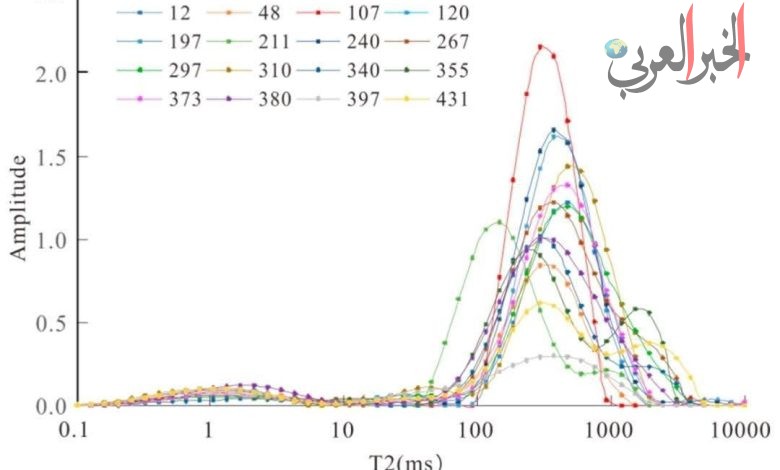
NMR relaxation distributions provide a conceptual framework for pore typing in carbonates. Rather than defining pore types purely by size, NMR-based classification considers fluid mobility and surface interaction.
Carbonate pore systems can be conceptually grouped into:
Bound-fluid-dominated pores, typically associated with microporosity and tight intercrystalline networks
Capillary-bound pores, which store hydrocarbons but contribute minimally to flow
Free-fluid pores, which dominate permeability and dynamic reservoir behavior
In carbonates, microporosity often contributes significantly to total porosity but minimally to permeability. NMR relaxation responses allow these microporous volumes to be identified and separated from macroporous flow units.
5. Microporosity Detection and Interpretation
Microporosity is one of the most critical challenges in carbonate reservoir evaluation. It is frequently invisible to conventional logs and difficult to quantify even with core analysis.
NMR provides a theoretical advantage by detecting microporosity through its rapid relaxation signature. Fluids confined in very small pores experience strong surface interactions, leading to short relaxation times that are diagnostic of microporous systems.
Understanding microporosity distribution is essential because:
It controls irreducible water saturation
It impacts hydrocarbon storage capacity
It influences recovery efficiency during production
From a theoretical perspective, NMR allows microporosity to be treated as a distinct pore system rather than as noise within total porosity measurement.
6. Pore Connectivity and Fluid Mobility Concepts
While NMR does not directly measure permeability, it provides indirect insight into pore connectivity through fluid mobility concepts. In carbonate reservoirs, connectivity is often more important than pore volume.
Pore systems with similar porosity may exhibit drastically different NMR responses depending on how well pores are interconnected. Large but isolated vugs may contribute to porosity but exhibit limited mobility, whereas smaller but well-connected pores can dominate flow.
Theoretical interpretation of NMR mobility in carbonates emphasizes:
Differentiation between storage and flow pore systems
Recognition of dual-porosity and multi-porosity behavior
Identification of pore systems controlling dynamic response
These concepts are critical for understanding why some carbonate reservoirs perform better than expected based on conventional petrophysical indicators.
7. Wettability and Surface Effects in Carbonates
Carbonate reservoirs often exhibit mixed or oil-wet wettability conditions, complicating saturation interpretation. Wettability directly influences NMR relaxation behavior through surface-fluid interactions.
In oil-wet or mixed-wet carbonates, relaxation mechanisms differ from those assumed in water-wet systems. This affects the distribution of relaxation times and challenges simplistic interpretations.
From a theoretical standpoint, NMR interpretation in carbonates must account for:
Variable surface relaxivity
Fluid-specific relaxation behavior
Wettability-dependent pore-fluid interactions
A conceptual understanding of these effects is essential for accurate pore system characterization and avoids misclassification of pore sizes or fluid types.
8. Integration of NMR with Carbonate Geological Models
NMR-based pore characterization gains its full theoretical value when integrated with carbonate depositional and diagenetic frameworks. Pore systems are not randomly distributed; they reflect geological history.
NMR responses can be conceptually linked to:
Depositional textures such as grain-supported versus mud-supported fabrics
Diagenetic alterations such as dissolution-enhanced porosity or cement-reduced connectivity
Structural influences including fracture-enhanced permeability
This integration transforms NMR from a standalone log into a geological interpretation tool capable of supporting reservoir modeling and conceptual flow unit definition.
9. Limitations and Interpretation Challenges
Despite its strengths, NMR interpretation in carbonates is not without challenges. Theoretical limitations include:
Overlapping relaxation signals from different pore systems
Sensitivity to surface chemistry variations
Ambiguity in relaxation cutoff concepts for complex pore networks
These challenges underscore the importance of interpretative expertise. NMR should be viewed as a pore system descriptor rather than a direct predictor of reservoir performance.
Conclusion
NMR-based pore system characterization represents a paradigm shift in the evaluation of carbonate reservoirs. Unlike conventional petrophysical tools, NMR responds directly to pore-scale fluid behavior, making it uniquely capable of resolving the complex, multi-scale pore systems that define carbonate reservoir performance.
From a theoretical perspective, NMR enables the differentiation between storage and flow porosity, highlights the role of microporosity, and provides insights into pore connectivity and wettability effects. When integrated with carbonate geological understanding, NMR becomes a powerful interpretative framework rather than a simple logging measurement.
Although interpretation challenges remain, particularly in heterogeneous and mixed-wet systems, the conceptual strengths of NMR far outweigh its limitations. As carbonate reservoirs continue to dominate global hydrocarbon resources, NMR-based pore system characterization will remain an essential theoretical foundation for advanced reservoir evaluation and management.
Written by Dr.Nabil Sameh
-Business Development Manager (BDM) at Nileco Company
-Certified International Petroleum Trainer
-Professor in multiple training consulting companies & academies, including Enviro Oil, ZAD Academy, and Deep Horizon , Etc.
-Lecturer at universities inside and outside Egypt
-Contributor of petroleum sector articles for Petrocraft and Petrotoday magazines, Etc.